
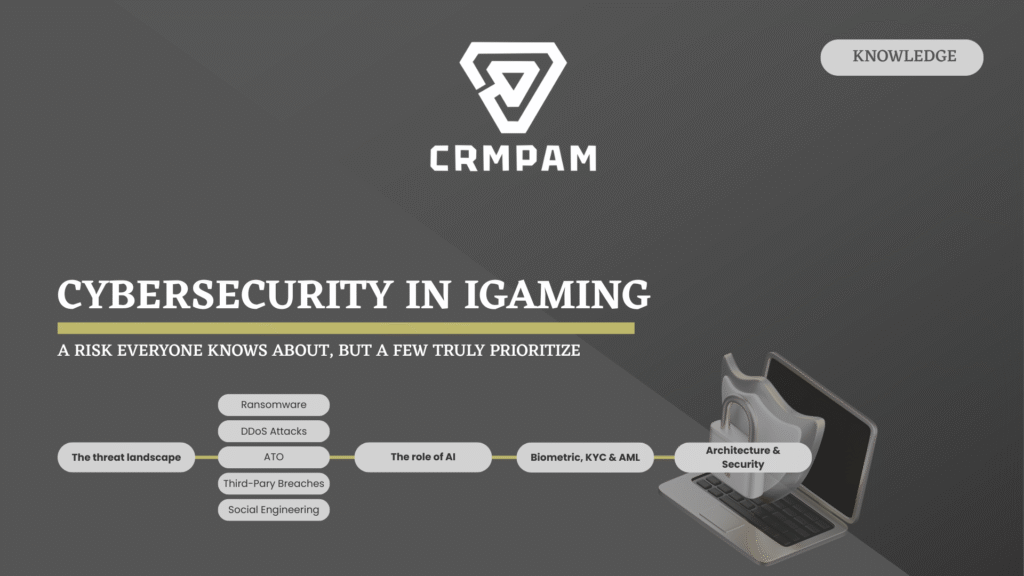
AI is increasing the sophistication of cyberattacks at the same pace it is improving detection capabilities. Online casinos are a prime target: real money, sensitive data, and nonstop transaction volumes.
Cybercrime is already one of the world’s biggest economic threats. It is estimated to cost the global economy $10.5 trillion annually by 2025, a figure larger than the GDP of most countries on the planet. In 2024, security breaches increased by 75% year-over-year, with organizations facing an average of 1,876 attacks per quarter.
Within this global landscape, the iGaming industry occupies a uniquely exposed position. Online casinos and betting platforms bring together everything an attacker could want in a single digital environment: real-time money movement, identity and financial data from millions of players, 24/7 availability as a non-negotiable requirement, and an architecture interconnected with dozens of third-party providers.
78% of online gambling operators have experienced at least one successful security incident in the past twelve months. The average recovery cost: $4.2 million per breach. In iGaming, trust is not a differentiator. It is the product.
The threat landscape: more complex, more coordinated, and more professional
The groups targeting iGaming platforms have moved far beyond the image of the lone opportunistic hacker. They now operate like organized companies, with resources, prior intelligence on their targets, and carefully selected attack vectors designed to exploit both the technical and human complexity of the industry. These are the most relevant threats, what they are, and how they specifically affect iGaming.
Ransomware: Ransomware is a type of malware (malicious software) that encrypts an organization’s systems and data, making them completely inaccessible, and demands payment (usually in cryptocurrency) in exchange for the decryption key.
The average ransom demand against gambling platforms reached $2.1 million during the first half of 2025, a 35% increase compared to 2024. In March 2025, three European online casinos suffered simultaneous attacks affecting more than 8.3 million player accounts, with combined ransom demands totaling $17.5 million in cryptocurrency.
Globally, ransomware was involved in 44% of all breaches analyzed by Verizon in its DBIR 2025 report, while FBI complaints increased by 9% year-over-year in 2024.
DDoS Attacks: A DDoS (Distributed Denial of Service) attack consists of overwhelming a platform’s infrastructure with massive volumes of fake traffic generated simultaneously from thousands or even millions of compromised devices, until servers collapse and the platform becomes inaccessible to legitimate users. It does not steal data or encrypt systems: it simply takes the service offline.
For iGaming, this is especially damaging for one specific reason: timing. A DDoS attack during a Champions League match, the Super Bowl, or any high-demand sporting event can result in millions in unprocessed bets, regulatory penalties for SLA violations, and massive player migration to competitors.
DDoS attacks increased by 46% in 2024 compared to 2023 according to Cloudflare, while application-layer attacks (the hardest to mitigate) grew by 15% during the second quarter of 2023.
Account Takeover (ATO): Account Takeover (ATO) occurs when an attacker gains access to a legitimate player’s account using their real credentials. The most common method is credential stuffing: attackers use massive databases of leaked username-password combinations from previous breaches and automatically test them against iGaming platforms.
In 2025, successful ATO attempts increased by 42% compared to the previous year, according to the Gambling Security Index. Attackers are also already using AI-powered tools to bypass conventional multi-factor authentication systems by simulating human behavioral patterns.
Third-Party Breaches: A modern iGaming platform is not a single system: it is an ecosystem of integrations. Live casino providers, payment gateways, KYC providers, affiliate platforms, CRM tools, analytics systems… Every integration represents a potential entry point. Attackers do not need to breach the operator’s platform directly. They only need to find the weakest link in the chain.
In 2025, 47% of successful attacks against gambling platforms originated through third parties. The January 2025 breach involving a major payment gateway simultaneously impacted 34 operators, exposing transaction data from 7.2 million users.Social Engineering: Social engineering is not a technical attack: it is a human attack. It consists of psychologically manipulating individuals within an organization into revealing credentials, executing unauthorized actions, or granting access they should never provide.
The role of AI: the same technology on different sides
On one side, attackers have adopted AI to industrialize sophistication. According to 2025 data, 85% of cybersecurity professionals attribute the increase in attacks to the use of generative AI by malicious actors. For the iGaming industry, this has direct and concrete implications.
Synthetic identities (combinations of real and fabricated data generated with AI) can bypass traditional KYC processes based on document verification. Liveness detection systems, designed to confirm that a user is a real person rather than a photograph, are now facing high-quality deepfakes capable of bypassing them. In April 2026, Slotegrator published a dedicated report warning that traditional KYC controls are no longer sufficient on their own against this threat. AI-generated phishing attacks produce highly personalized messages adapted to the tone and context of each target. Bots automating credential stuffing now operate with behavioral sophistication that mimics human activity, allowing them to evade pattern-based detection systems.
On the other side, AI is also the most powerful response to these threats precisely because it operates at a speed and scale no human team can match. Machine learning-based fraud detection systems analyze behavior in real time (typing speed, mouse movements, session patterns, devices used, access geography) to identify anomalies that static rule-based systems fail to detect.
iGaming platforms implementing these combined security layers report up to 76% fewer successful breaches compared to those relying only on basic controls. AI-driven fraud detection systems in iGaming have evolved from simple rule-based alerts into predictive models capable of identifying complex fraud schemes.
Biometric authentication, KYC, and AML
For years, KYC in iGaming essentially consisted of verifying an identity document. The user uploaded a passport photo, an agent manually reviewed it, and the process ended. That model has a fundamental problem: it assumes the documents are authentic and that the person presenting them is who they claim to be. In 2025, both assumptions are questionable.
Digital document forgery increased by 244% year-over-year according to the 2025 Identity Fraud Report. Synthetic identities already account for more than 80% of fraud in new account openings, according to Experian. And high-quality deepfakes can now bypass liveness detection systems that worked perfectly just eighteen months ago.
The industry’s response, also driven by regulators who have significantly tightened their requirements, has been to build multiple layers of protection:
Advanced-Biometric liveness detection: Comparing a photo to a document is no longer enough. Modern KYC systems in iGaming now require proof that the user is a live, present individual through micro-expression analysis, real-time movement challenges, and deepfake artifact detection. The goal is to counter the growing threat represented by the 40% of biometric fraud attempts that already use deepfakes.
Source of wealth: For high-value players, 2025 AML standards require operators to document not only where the money for a specific deposit comes from, but also how the player’s wealth was generated. This requires Enhanced Due Diligence (EDD) processes involving real financial document reviews, not just database checks.
Real-time AML monitoring: AML systems have evolved into predictive models capable of detecting complex behavioral patterns in real time (velocity of fund movement, high-risk jurisdiction activity, and networks of linked accounts)National digital identities: Markets such as Sweden have already integrated national digital identity systems like BankID into iGaming onboarding flows. Brazil, regulated since January 2025, established real-time integration with its CPF database. The trend clearly points toward identity verification supported by government-backed infrastructure, reducing dependence on traditional document verification.
Conclusion: architecture and security
There is a conversation the iGaming industry rarely has explicitly: software architecture is not only a performance and scalability decision. It is a decision that determines the attack surface, the speed of incident response, and the ability to contain damage.
In a properly implemented microservices architecture, each service becomes an isolated security domain. Compromising one microservice does not automatically grant access to payment services or player identity databases. Segmentation becomes structural, not dependent on network configuration.
The relevant question for industry leaders is not whether they will suffer an attack. The real question is whether, when it happens, their platform architecture, response processes, and security controls will turn it into a contained incident — or into an event that negatively redefines the company itself.
CRMPAM – The quiet power behind your wildest traffic