
For many years, payment management in iGaming has been a critical friction point that generated significant challenges: checkout friction, card declines, fraud, high operational costs, and inefficient response times.
But Open Banking has arrived to change that dynamic. What began as a regulatory initiative in Europe is becoming a real and strategic alternative for moving money instantly, securely, and more efficiently. And for iGaming (where speed, conversion, and security are everything) the impact is direct.
What is Open Banking and why is it Growing in Europe?
Open Banking emerged in Europe in 2015 with the adoption of PSD2 (Payment Services Directive 2), which requires banks to allow access (with user consent) to authorized third-party providers through secure APIs.
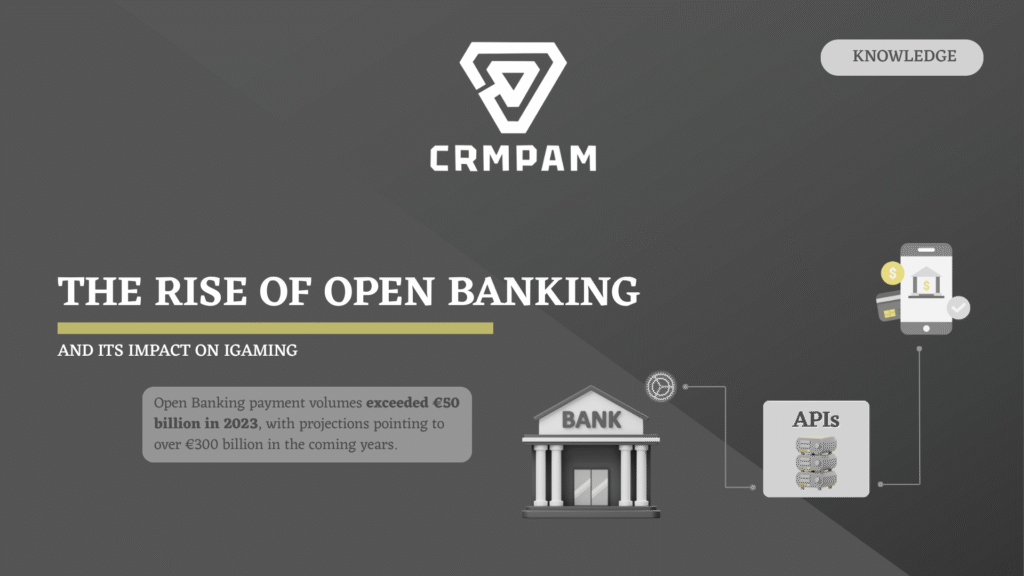
In practical terms, Open Banking enables a direct connection between a user’s bank account and the merchant, without the need for cards or traditional intermediaries. The growth trajectory is clear. In the United Kingdom, Open Banking transactions increased from 68 million in 2022 to 130 million in 2023, nearly 90% year-over-year growth. Globally, Open Banking payment volumes exceeded €50 billion in 2023, with projections pointing to over €300 billion in the coming years.
This expansion is driven by three clear market needs: faster payments, enhanced security, and reduced dependence on traditional card networks.
Why is one of the Most Impacted Sectors?
The answer is clear: users in this market increasingly seek immediacy. A delayed deposit, a rejected payment, or a complex transaction can mean a lost user. And that is why Open Banking fits perfectly in this sector. In markets such as the United Kingdom, up to 20% of deposits on iGaming platforms are already made through Open Banking methods.
Instant Payments and Less Friction
With Open Banking, the user authorizes the payment directly from their bank. Without entering card numbers or relying on traditional payment gateways. The result is fewer steps at checkout and therefore a lower user abandonment rate in the process.
Fraud Reduction and Lower Operational Costs
Fraud in online payments is a structural problem. Account-to-account payments reduce common fraud vectors associated with stolen cards or chargebacks. In addition, the involvement of fewer intermediaries in the process results in lower fees for the end user, and this directly impacts the operator’s margin.
Better Control of Fund Flows
Open Banking allows greater traceability and visibility of transactions. For iGaming platforms, this means greater financial transparency, better control over liquidity, and clearer information for regulatory reporting.
Direct Impact on Conversion and LTV
The true importance of Open Banking in iGaming lies not only in improving payments, but in how this improvement translates into key metrics that directly affect profitability and business growth.
Numerous industry studies show that clarifying payment timelines and options can increase conversion rates by around 21%. Therefore, when operators offer methods considered faster and more reliable, the probability of completing a deposit increases significantly.
In addition, this payment system has a positive effect on how users perceive the platform, as players value aspects such as funding their account during live events or the possibility of withdrawing winnings without delay. Industry data shows that 69% of players indicate that withdrawal delays negatively affect their trust in the platform, considering switching platforms for faster processing.
In conclusion, we can say that payment systems directly influence two key LTV variables: player retention, as players who experience frictionless payments tend to stay longer, and higher deposit recurrence, as these payment solutions make it easier for players to deposit more frequently, especially during high-activity events.
Special Relevance in Regulated Markets
The European market is not homogeneous; it is a highly regulated ecosystem by region. Countries such as Spain, Italy, Germany, or the Nordic countries require strict AML controls, fund traceability, and very demanding KYC processes. These regulations are part of the licensing conditions to operate, and the European Gaming and Betting Association (EGBA) works actively with regulators to ensure the market is legal and safe for consumers.
In this context, Open Banking becomes a regulatory asset because: It allows direct validation of the source of funds automatically, facilitates compliance with AML and KYC rules without manual intervention, and provides full traceability of player deposit or withdrawal transactions.
This level of traceability and automation reduces the risk of regulatory sanctions, a crucial factor for operators competing in these markets.
Conclusion: Open Banking as a Future Tool in iGaming
This payment system is becoming a financial infrastructure with deep implications for highly regulated and transactional sectors such as iGaming.
The data supports this: the accelerated growth of account-to-account payments, sustained adoption in markets such as the United Kingdom, and the increase in transactional volume in Europe demonstrate that Open Banking is ceasing to be a marginal option and becoming a central part of the digital payments ecosystem.
For iGaming, the impact is clear: faster deposits and withdrawals, reduction of fraud and chargebacks, higher conversion at the most critical moment of the funnel, increased recurrence and therefore higher LTV, and more efficient compliance in regulated markets.
CRMPAM – The quiet power behind your wildest traffic