
The iGaming landscape in Latin America continues to expand rapidly, with Brazil standing out as the region’s most significant growth driver. Beyond being the largest country in LATAM in terms of population (with over 200 million inhabitants) Brazil combines scale with a strong consumption culture deeply rooted in entertainment and, most notably, sports.
For years, the Brazilian market operated within a certain level of regulatory ambiguity. This environment allowed international operators to enter and grow without a fully defined legal framework. However, the most significant shift has occurred recently, as Brazil moves toward a regulated model that is fundamentally reshaping the competitive landscape.
Market Size and Growth Outlook
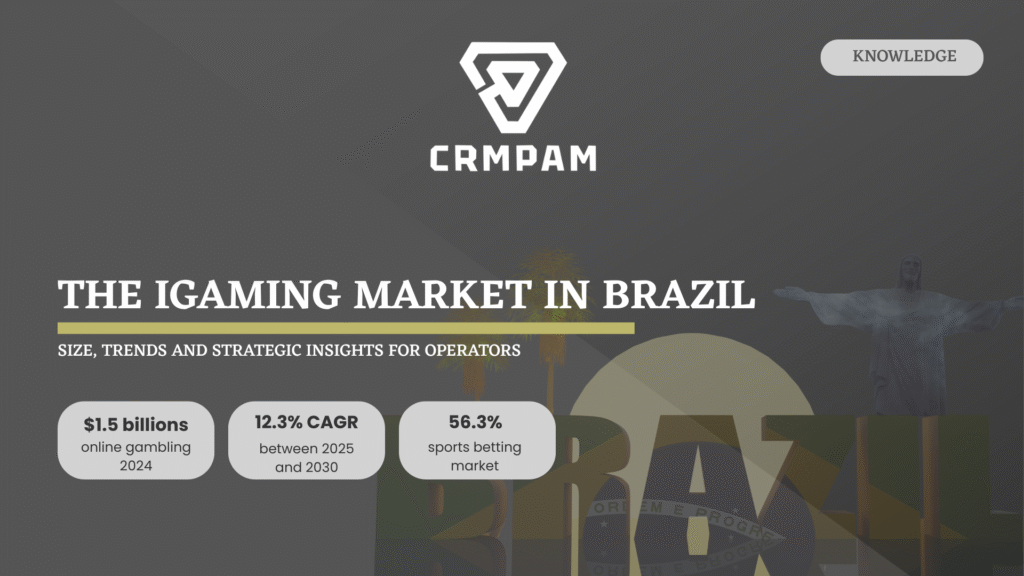
Brazil is already one of the largest iGaming markets in Latin America, and all indicators point toward sustained and accelerated growth. The online gambling market reached approximately $1.5 billion in 2024, and projections suggest a strong upward trajectory in the coming years.
Market forecasts estimate that Brazil could reach around $3.9 billion by 2030, with a compound annual growth rate (CAGR) of 12.3% between 2025 and 2030. Even more notably, the market is expected to generate a Gross Gaming Revenue (GGR) of $7 billion by 2025, reflecting not only organic growth but also the direct impact of regulation and increased market participation.
Although Brazil currently represents around 1.9% of the global iGaming market, its relative weight is expected to increase significantly. The combination of scale, growth potential, and regulatory evolution creates a scenario where operators that establish a strong position early can secure a long-term competitive advantage that will be difficult to replicate later.
Sports betting: The Core Growth Engine
Sports betting is, without question, the main driver of the Brazilian iGaming market. This vertical currently accounts for approximately 56.3% of total market revenue, making it the primary entry point for new users.
This dominance is closely tied to Brazil’s deeply ingrained sports culture, with football playing a central role. The continuous flow of local leagues, international competitions, and global events ensures year-round engagement and betting activity.
From a strategic perspective, however, the real value of sports betting lies beyond volume. Sportsbooks play a critical role in the acquisition funnel. In many cases, they serve as the initial touchpoint for user acquisition, enabling operators to onboard players at relatively efficient costs before transitioning them toward casino products, where margins are typically higher. This dynamic requires platforms to deliver a seamless, integrated experience across verticals, ensuring that user journeys are fluid and optimized for cross-sell opportunities.
The Brazilian Player and the Critical Role of Payment Methods
The Brazilian player profile is a defining factor in understanding the market’s dynamics. The user base is relatively young, with approximately 60% of players aged between 18 and 34, and the largest segment concentrated in the 25–34 age group, which alone represents 35% of the total.
This demographic profile implies a high level of digital literacy and elevated expectations when it comes to user experience. Brazil is a mobile-first market, where the majority of interactions with iGaming platforms take place on smartphones. As a result, performance, speed, and usability are not differentiators—they are baseline requirements.
Another defining characteristic of Brazilian users is their expectation of immediacy. Actions such as registration, deposits, betting, and withdrawals are expected to be completed within seconds. This expectation is heavily influenced by the widespread adoption of digital solutions in other areas, particularly in payments.
In this context, payment methods are not simply an operational component—they are a critical success factor. The introduction of PIX, the instant payment system developed by the Central Bank of Brazil, has fundamentally transformed how users interact with online platforms.
With over 150 million active users, PIX enables real-time, 24/7 transactions, effectively eliminating friction in both deposits and withdrawals. Its widespread adoption has redefined user expectations and set a new standard for speed and convenience in the iGaming experience.
Alongside PIX, alternative methods such as Boleto Bancário remain relevant, particularly among less banked segments or users seeking greater control over spending. Local e-wallets are also gaining traction, especially among younger audiences.
Ultimately, success in Brazil requires more than offering multiple payment options. It demands seamless integration, real-time processing, and full alignment with local user behavior. In a market where friction in payments can directly impact conversion and retention, this becomes a key lever for growth.
Regulatory Landscape in Brazil: Current Status and Recent Developments
The regulatory framework has historically been one of the most complex and uncertain aspects of the Brazilian iGaming market. For years, the country operated in a grey area where online betting was neither fully regulated nor explicitly prohibited, allowing international operators to enter without a clear legal structure.
This began to change with the approval of legislation authorizing fixed-odds sports betting at the federal level, marking the starting point of a broader regulatory process. In recent years, the Brazilian government has accelerated its efforts to establish a comprehensive framework, laying the groundwork for licensing, taxation, and operational control.
A central component of this new model is the introduction of a licensing system requiring operators to meet strict technical, financial, and regulatory standards in order to operate legally. This includes the implementation of robust Know Your Customer (KYC) processes, Anti-Money Laundering (AML) measures, and responsible gaming mechanisms.
In addition, the regulatory framework addresses key areas such as advertising, data protection, and consumer rights, significantly raising the bar for operators entering the market.
From a fiscal perspective, Brazil is also defining a taxation model aimed at balancing market attractiveness with public revenue generation. While some aspects continue to evolve, it is clear that the cost of entry will be significant, favoring operators with strong financial and technological capabilities.
Perhaps most importantly, regulation is expected to reshape the market structure. By reducing the presence of unregulated operators and increasing user trust, it creates a more sustainable environment while simultaneously raising entry barriers. This will likely accelerate consolidation and strengthen the position of well-established players.
Competiton and Leading Operators
Brazil has rapidly become one of the primary investment targets for international iGaming operators. Major brands such as Bet365, Betano, Betsson, and Betway have established a strong presence in the market, supported by aggressive acquisition strategies.
One of the most visible aspects of this competition is the surge in sports sponsorships. In recent seasons, more than 70% of Brazil’s top-tier football clubs have been sponsored by betting operators, highlighting both the intensity of competition and the strategic importance of sports as an acquisition channel.
At the same time, the Brazilian market is characterized by the coexistence of global operators and local or regional players. Local brands, such as Pixbet, have gained traction by leveraging a deeper understanding of user behavior, stronger alignment with local payment systems like PIX, and more tailored pricing strategies.
This dynamic creates a competitive environment where scale alone is not sufficient. Execution becomes the key differentiator. Factors such as speed of integration, payment efficiency, user experience optimization, and operational agility play a decisive role.
Additionally, the cost of acquisition in Brazil is among the highest in LATAM, driven by intense competition across digital channels and increasing saturation of promotional campaigns. As a result, operators must focus not only on acquisition, but also on retention, monetization, and overall operational efficiency.
Conclusion: Brazil as a Strategic Priority for iGaming Operators
Brazil has firmly established itself as one of the most relevant iGaming markets globally, driven by its scale, rapid growth, evolving regulatory framework, and digitally mature user base.
However, this opportunity comes with equally high demands. Competition is intense, user expectations are rising, and the regulatory landscape continues to evolve.
In this environment, operators looking to succeed in Brazil must go beyond simple market entry strategies. Long-term success will depend on combining local market understanding, operational excellence, and a technological foundation capable of adapting to a fast-changing and highly competitive environment.